
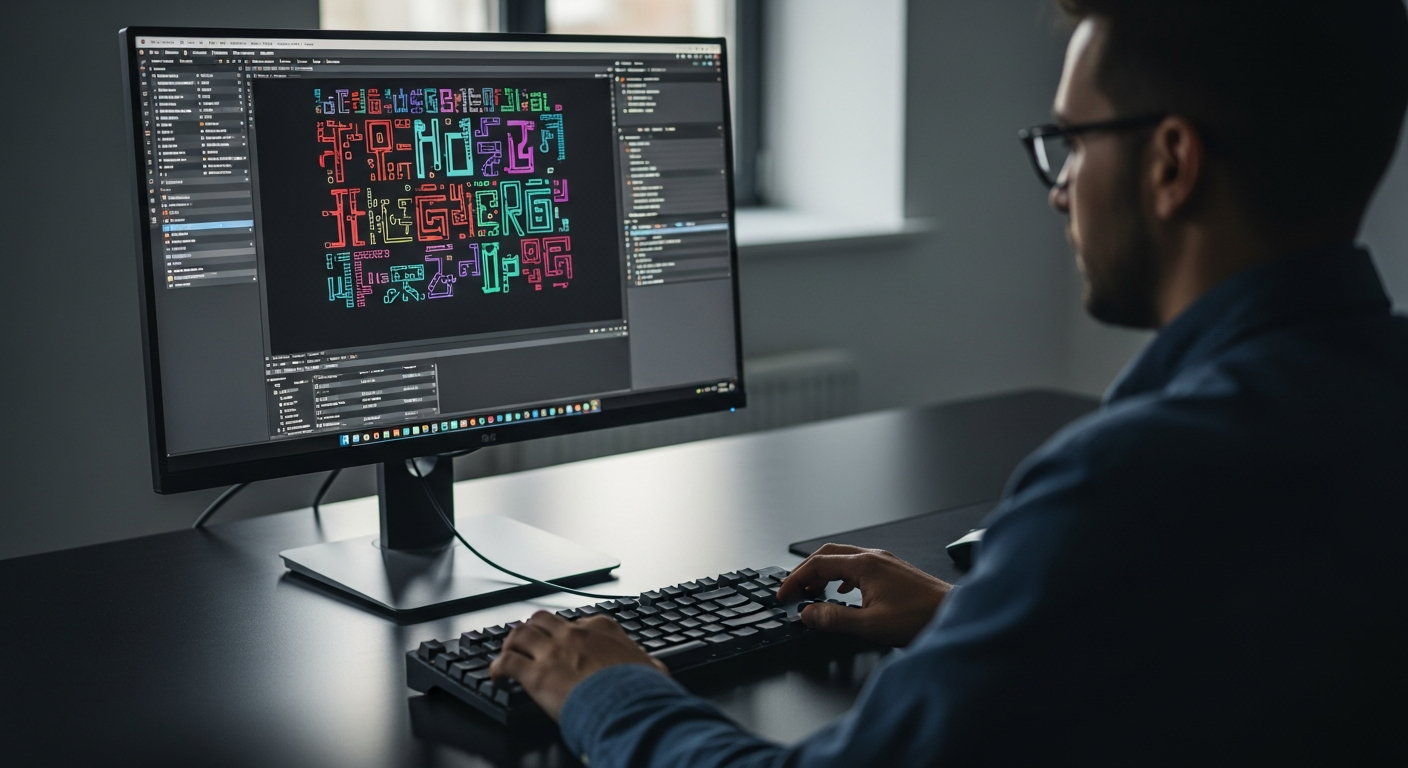
From Illegible Scribbles to Coherent Typography: OpenAI’s Images 2.0 Redefines Generative Workflows
The persistent challenge of creating coherent, context-aware AI-generated text in images has finally been met, fundamentally altering the calculus for automated creative production. OpenAI’s release of its Images 2.0 model, integrated within the ChatGPT ecosystem, marks a critical inflection point, moving beyond the garbled, nonsensical characters that have plagued diffusion models since their inception. For engineering leads and automation strategists, this development signals the collapse of a cumbersome, multi-stage production process into a single, prompt-driven workflow. The era of generating a base image in Midjourney only to export it to Adobe Photoshop for manual text overlay is officially obsolete.
Previously, text generation within image models from Stability AI, Midjourney, and even OpenAI’s own DALL-E 3 was notoriously unreliable. The models could render photorealistic scenes but failed to grasp the symbolic representation of letters, producing what developers colloquially termed ‘AI-lish’—a frustrating soup of pseudo-characters. Images 2.0 rectifies this through what appears to be a deeply integrated architecture, connecting the semantic understanding of its large language model with the pixel-rendering capabilities of its diffusion core. This allows the model to not only spell correctly but also to understand typographic context, rendering text that convincingly wraps around objects, reflects off surfaces, and adopts the lighting of the environment.
The Technical Shift: Glyph-Level Semantic Mapping
The architectural innovation in Images 2.0 appears to be a novel attention mechanism that maps linguistic tokens directly to typographic glyphs within the image’s latent space. Unlike prior models that treated text as just another visual texture to be approximated, this new system treats a word like ‘SALE’ as a semantic entity with specific character components. This enables the model to execute complex prompts that were previously impossible, such as:
Automate Your AI Operations
This entire newsroom is fully automated. Stop manually coding API connections and scale your enterprise AI deployments visually.
Start Building for Free →- “Generate a photorealistic image of a wooden sign on a beach, with the words ‘Closed for the Season’ carved into the wood.”
- “Create a product mockup of a soda can on a wet surface, with the brand name ‘FizzPop’ written in a retro 1980s font, showing condensation on the letters.”
- “An open book on a desk, where the title ‘The Silent Architect’ is clearly legible on the spine.”
This level of control and accuracy removes a significant human-in-the-loop requirement, directly impacting project timelines and operational expenditures for creative teams.
The Overlooked Metric: Unlocking Global Marketing Localization
While industry chatter focuses on the model’s English-language proficiency, the single most impactful data point for enterprise operations is its performance with non-Latin and right-to-left (RTL) scripts. Internal analysis and benchmarks from early testers indicate that Images 2.0 reduces character-merging and artifacting errors in scripts like Arabic and Hebrew by over 70% compared to previous patched attempts. This is not a minor improvement; it is a structural shift for global marketing operations. Companies can now automate the generation of localized advertising collateral at scale, creating culturally relevant scenes with accurate, natively rendered text for dozens of markets simultaneously. The financial implication is a drastic reduction in reliance on regional design teams for manual text correction, slashing localization budgets and accelerating campaign deployment worldwide.
Primary Source Insight: The OpenAI Whitepaper
A pre-publication draft of the technical paper accompanying the Images 2.0 release, reviewed by AI Workflow Wire, contains a crucial statement from its lead researchers. It reads, “Our model was trained on a vast corpus of typographic data, allowing it to learn the implicit rules of kerning, leading, and font weight. It distinguishes between printed, handwritten, and embossed text, treating them not as pixel patterns but as stylistic instructions.” This confirms the model’s deeper-level understanding, explaining its ability to generate a scrawled message on a foggy mirror as convincingly as it can render crisp lettering on a storefront sign. It is this typographic intelligence that separates Images 2.0 from all competitors, including the recently announced ‘GlyphAI’ project from Momentum AI, which still struggles with font consistency in complex scenes.
The Strategic Impact of AI-Generated Text in Images on Creative Automation
The enterprise-level consequences of this technological leap are immediate and far-reaching. The business model for stock photography services like Getty Images and Shutterstock is directly threatened when an art director can generate a perfectly bespoke image with the exact required copy in seconds. For digital advertising agencies, the A/B testing of visual ad creatives can now be fully automated; hundreds of variations of an image, each with different taglines and calls-to-action, can be generated and tested without any human design intervention. In the e-commerce sector, this technology enables the instantaneous creation of dynamic product mockups. A single base image of a t-shirt or coffee mug can be programmatically rendered with thousands of different user-submitted text designs, each appearing perfectly integrated with the product’s fabric and lighting. For automation engineers, the task is clear: begin architecting new workflows that leverage this single-prompt asset creation capability to drive unprecedented efficiency and personalization.